
GitHub Internal Repositories Breached via Malicious Nx Console VS Code Extension

Trust in open-source maintainers. Trust in extension marketplaces. Trust in automatic updates silently running in the background every day across millions of developer systems. But the breach affecting GitHub’s internal repositories demonstrates how quickly that trust can collapse when attackers compromise the software supply chain itself.
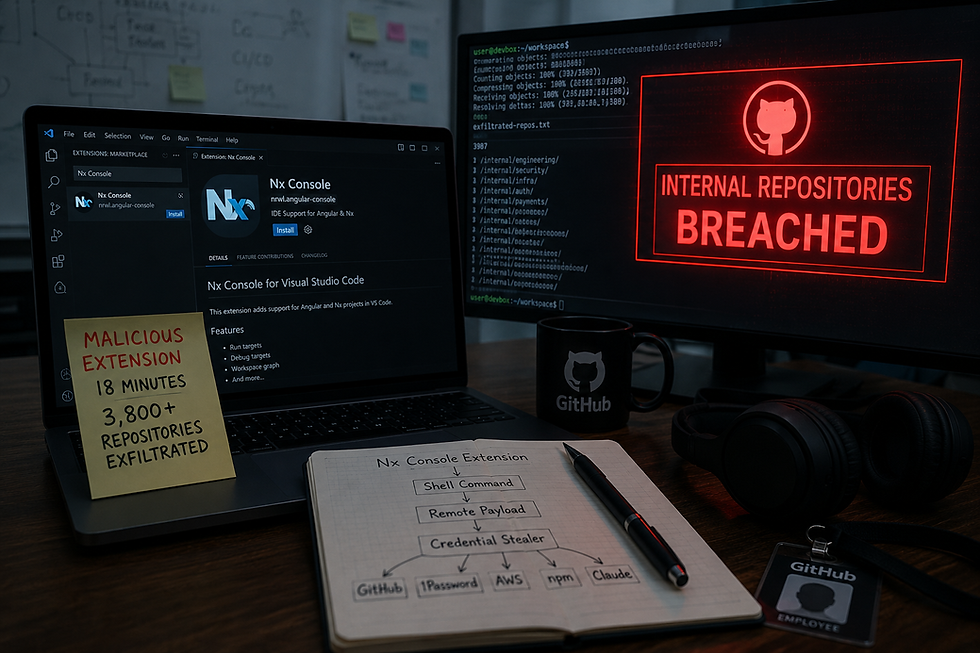
What began as a poisoned Visual Studio Code extension ultimately escalated into the theft of approximately 3,800 internal GitHub repositories after attackers linked to TeamPCP weaponized a trojanized version of the Nx Console extension. Although the malicious release remained online for only eighteen minutes, that brief window was enough to compromise developer systems, harvest credentials, and create another link in an expanding chain of interconnected software supply chain attacks.
The incident highlights a growing reality across the development ecosystem: the compromise of one trusted developer tool can rapidly become the compromise of many others.
Phase 1: The Supply Chain Starts to Fracture
The compromise traces back to the broader TanStack supply chain attack, an operation that impacted several high-profile organizations and developers connected to the open-source ecosystem.
Among the victims was a developer associated with the Nx Console extension, also known as nrwl.angular-console, published for Visual Studio Code. After the developer’s environment was compromised, attackers gained the ability to publish a malicious version of the extension directly to the Visual Studio Marketplace.
This stage reflects one of the most dangerous aspects of modern software supply chain attacks: attackers increasingly target trusted maintainers rather than end users directly.
By compromising a legitimate publisher account, threat actors inherit the trust already established between developers and the software they routinely install and update automatically.
The attackers did not need to trick users into downloading unknown malware. The marketplace itself became the delivery mechanism.
Phase 2: Eighteen Minutes of Exposure
The malicious extension was available on the Visual Studio Marketplace for only eighteen minutes.
Under normal circumstances, such a short exposure window might appear insignificant. But modern developer tooling ecosystems operate at machine speed.
Extensions automatically update by default across many development environments, including VS Code and related editors. Once the malicious update was published, infected systems immediately began pulling the poisoned release without requiring manual interaction.
This automatic trust pipeline transformed a brief marketplace compromise into a high-speed malware distribution operation.
The extension appeared legitimate and behaved normally enough to avoid immediate suspicion. Hidden beneath its standard functionality, however, was a malicious startup routine designed to silently execute attacker-controlled code in the background.
The compromise demonstrates how even extremely short-lived malicious updates can cause large-scale damage when distributed through trusted auto-update infrastructure.
Phase 3: The Hidden Shell Command
Once installed, the poisoned extension silently executed a concealed shell command.
According to researchers, the command downloaded and launched a hidden package from a malicious commit planted inside the official nrwl/nx GitHub repository. The execution chain was disguised as a routine MCP setup task, helping it blend into legitimate development activity.
This subtle disguise was critical.
Developers routinely execute package installations, scripts, environment setups, and automated tooling commands as part of normal workflows. By embedding malicious activity into processes that already appear operationally normal, attackers dramatically reduced the likelihood of immediate detection.
The payload functioned as a credential stealer focused specifically on developer environments and privileged tooling ecosystems.
Rather than targeting traditional end-user information, the malware prioritized secrets capable of enabling deeper supply chain compromise.
Phase 4: Harvesting the Developer Ecosystem
The malware aggressively targeted sensitive development credentials and cloud infrastructure secrets.
Among the harvested data were:
GitHub credentials and authentication tokens
npm tokens
Amazon Web Services (AWS) secrets
1Password vault data
Anthropic Claude Code configurations
Additional developer environment secrets
This targeting strategy reflects the evolving priorities of modern cybercriminal groups.
Developer workstations increasingly function as central control points for cloud infrastructure, CI/CD pipelines, repositories, deployment systems, AI tooling, and package ecosystems. Compromising a single privileged developer machine can provide attackers with cascading access across multiple interconnected platforms.
The compromise of developer tooling therefore becomes far more dangerous than traditional endpoint infection.
In many cases, developer credentials effectively become infrastructure credentials.
Phase 5: GitHub Internal Repositories Exfiltrated
The stolen credentials eventually enabled TeamPCP to access and exfiltrate approximately 3,800 internal GitHub repositories.
GitHub later confirmed that the breach originated from a compromised employee device involving the poisoned Nx Console extension. The company stated that there was no evidence of compromise affecting customer repositories or customer environments directly, although some internal repositories contained excerpts of customer support interactions.
The attackers leveraged the trust relationships embedded within the software ecosystem itself.
One compromised tool led to stolen credentials. Those credentials enabled access to additional trusted environments. Those new environments created opportunities for even broader compromise.
This recursive compromise cycle has become one of the defining characteristics of modern supply chain attacks.
Phase 6: The Auto-Update Problem
One of the most important lessons from the incident involves the hidden risk of automatic extension updates.
For years, auto-update systems have been viewed primarily as a security benefit because they help users rapidly receive patches and vulnerability fixes. But when trusted publishers themselves become compromised, those same update mechanisms transform into attacker-controlled distribution channels.
The attack against Nx Console demonstrates how marketplaces currently impose little delay between publication and deployment.
Once a malicious update is pushed by a trusted publisher, thousands of systems may ingest it almost immediately.
The compromise also exposes deeper structural weaknesses in modern open-source ecosystems:
Heavy trust concentration around maintainers
Limited publisher verification
Minimal review gates for extension updates
Deep interconnectivity between development tools
Broad credential exposure on developer systems
As attackers increasingly target maintainers, repositories, CI/CD environments, and extension ecosystems, software supply chain security is rapidly becoming one of the most critical cybersecurity battlegrounds.
Measures to Fend Off Developer Tooling Supply Chain Attacks
Restrict or delay automatic extension updates in sensitive environments.
Enforce least privilege access for developer credentials and repositories.
Separate development accounts from production infrastructure access.
Monitor shell execution and unusual child processes launched by extensions.
Continuously audit installed extensions and plugins across developer systems.
Implement hardware-backed MFA for privileged developer accounts.
Store secrets in isolated vault systems with strict segmentation controls.
Monitor marketplaces and repositories for unauthorized or unexpected updates.
Deploy behavioral detection focused on developer workstations.
Limit persistent cloud credentials stored locally on endpoints.
Conduct continuous supply chain risk assessments for open-source tooling.
Review CI/CD pipelines and repository permissions regularly.
Conclusion
The GitHub repository breach demonstrates how modern software supply chain attacks increasingly exploit trust itself as the primary attack surface.
The malicious Nx Console extension remained online for less than twenty minutes, yet that brief exposure was sufficient to compromise developer systems, steal privileged credentials, and ultimately expose thousands of internal repositories.
The incident also reveals a dangerous shift in attacker strategy. Threat actors are no longer simply targeting vulnerable software; they are targeting the very mechanisms developers rely on to build, update, and distribute trusted code.
Every compromised maintainer account, poisoned extension, or malicious package creates another stepping stone toward the next supply chain breach.
And in highly interconnected development ecosystems, compromise no longer stops at a single victim.


Comentarios